neural networks & ai
summer camp @ constructor school, together with Meri Grigoryan
topological sort and neural network pruning
by Darshan Surajmal
One studies topological sorting, an algorithmic method from graph theory, to prune neural networks efficiently. This is done by understanding dependencies between layers or neurons.
deliverables
1. Understanding Directed Acyclic Graphs (\(\mathbf{DAG}\)s) and Topological Sort
Introduce the concepts of graphs, directed graphs, and directed acyclic graphs (\(\mathbf{DAG}\)s). Explain what topological sort is and why it is only defined for DAGs.
Requirements
- Define graphs, directed graphs, and \(\mathbf{DAG}\)s with simple examples.
- Explain why cycles prevent topological sorting.
- Describe the purpose of topological sort.
- Bonus. Include a small \(\mathbf{DAG}\) and its topological order.
2. Topological Sort Algorithm and Complexity
Using Kahn’s algorithm, explain how the topological sort algorithm works and analyze its time complexity.
Requirements
- Present the algorithm steps clearly and concisely.
- Define the input (a \(\mathbf{DAG}\)) and output (a linear ordering).
- Provide a hand-drawn pseudocode or a flowchart.
- Analyze the Big-O time complexity and explain why it is efficient.
3. Applying Topological Sort to Neural Network Pruning
Describe how a neural network’s layers or neurons can be represented as a DAG and how topological sort helps prune redundant or unnecessary parts without breaking dependency order.
Requirements
- Discuss the neural network pruning problem.
- Transform the pruning problem to a \(\mathbf{DAG}\) problem. How can we do this, and what is the connection?
- What is topological order, and why is it important for the neural network?
4. Reflection
Reflect on the insights gained about the interplay between graph algorithms and neural networks.
Requirements
- Summarize key takeaways about topological sorting.
- Reflect on the challenges of applying graph theory in neural network optimization.
bonus deliverable
Model the following neural network as a Directed Acyclic Graph (\(\mathbf{DAG}\)) and perform pruning using topological sort. Use the rules provided below.
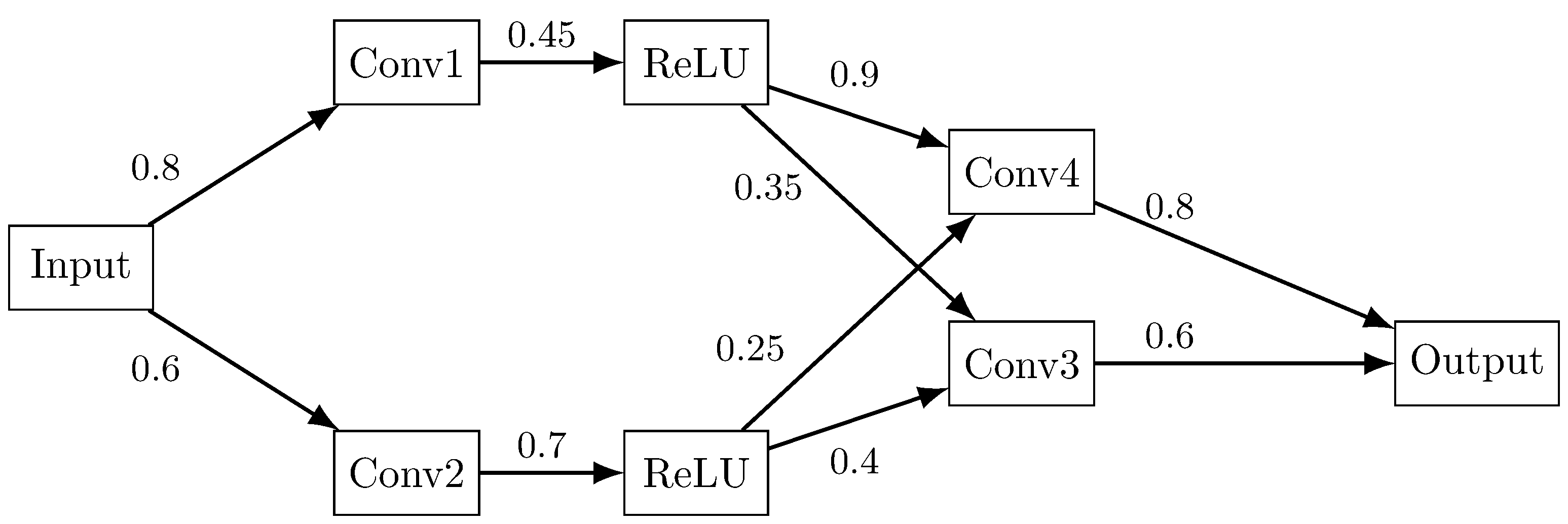
Pruning Rules
- Prune edges with weight \(< 0.5\)
- Remove orphaned nodes (nodes with no incoming edges except Input, no outgoing edges except Output)
- Process nodes in reverse topological order
Tasks
- Generate a valid topological order (consider only edges, ignore weights)
- Simulate pruning in reverse topological order:
- For each node, prune incoming edges with weight \(< 0.4\)
- Remove orphaned nodes immediately
- Track graph changes at each step
- Draw the final pruned network
Bonus. What happens when we prune without topological sort?1
Resources
- Topological Sort Graph Algorithm. Tushar Roy.
- Topological Sorting. GeeksforGeeks.
- A beginner’s Guide to Neural Network Pruning. Vijaysinh Lendave.
-
Pruning without topological order might break dependencies, removing nodes that are still needed for forward propagation, or leaving behind orphaned nodes that cannot be safely removed because their successors haven’t been processed yet. ↩